Post
18 October 2026
2027 HR Salary Guide Australia: HR Salaries & Career Paths
The modern HR market landscape is evolving. Employers and HR professionals alike want to know what they’ll earn in 2027. HR salary guide is only part of the picture. Professionals also need to understand which capabilities help them move from $150k to $200k, and eventually into $300k+ executive roles. Employers, in turn, need to understand…

The modern HR market landscape is evolving. Employers and HR professionals alike want to know what they’ll earn in 2027. HR salary guide is only part of the picture. Professionals also need to understand which capabilities help them move from $150k to $200k, and eventually into $300k+ executive roles. Employers, in turn, need to understand those same capabilities to attract, retain and fairly reward the right talent.
This guide helps employers and HR professionals stay up to date on the latest HR salaries in Australia and learn more about HR career path development. It covers five important areas that include:
- HR salary benchmarks: the different roles that are likely to pay in 2027.
- Career progression: how professionals move from one level to the next.
- What drives salary premiums: the skills and experience the market rewards.
- The impact of AI: how technology is reshaping HR roles and pay.
- What employers need to consider when benchmarking HR talent: factors to weigh.
2027 HR Salary Guide: HR Salaries at a Glance
Here is the 2027 HR Salary Guide, broken down by HR role, indicative salary range, and typical level.
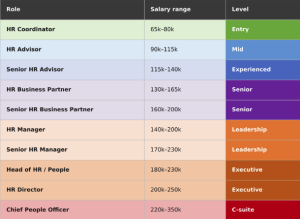
HR salary guides depend on more than job title. A professional’s market value is determined by several interconnected factors, such as:
- Years of experience: Experience in handling difficult issues.
- Organisation size: Larger organisations often face greater operational complexity.
- Team size: Larger teams introduce greater leadership and operational challenges.
- Industry: Different sectors value HR differently.
- Geographic responsibility: Managing a single site differs from covering multiple markets.
- Strategic responsibility: Taking action and owning the business strategy.
- Employee/industrial relations expertise: Capable of building positive relationships between the business and its people.
- Leadership capability: Able to lead, influence, and drive change.
- Commercial experience: Practical knowledge of core business operations and profitability.
In summary, two people with the same job title can have significantly different market values depending on the scope and complexity of their role.
HR Career Path: From HR Coordinator to HR Director
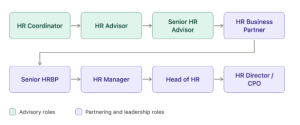
An HR career typically begins with running processes, then moves to advising on people issues, and finally to shaping how the organisation manages its workforce. At each stage, the work becomes less operational and more strategic.
- HR Coordinator
At the entry level, the HR Coordinator role centres on HR administration, the employee lifecycle, HR systems, and supporting HR teams. - HR Advisor
As HR Coordinators gain experience, the HR career ladder opens the path to HR Advisors. The position centres on employee relations, performance management, policies and stakeholder support. - HR Business Partner (HRBP)
The HRBP role shifts from advisory to partnering and leadership. HRBP work alongside business leaders, focusing on strategic partnering, workforce planning, leadership advice, and business strategy. - HR Manager
HR Managers own the HR function, lead teams, and drive people strategy and organisational priorities. - Head of HR / HR Director
The top HR career path is the Head of HR or HR Director. These roles focus on the enterprise workforce strategy, executive leadership, organisational transformation, culture and long-term workforce planning.
While the climb from Coordinator to Director visually represents a single route, no single HR career path exists.
HR professionals can also advance their HR career path development by specialising in key areas, such as:
- Employee Relations
- Industrial Relations
- Talent Acquisition
- Learning & Development
- Organisational Development
- Reward & Remuneration
- People & Culture
What Gets an HR Professional From $150k to $200k to $300k+?
What moves someone up a salary band depends on broader responsibilities, stronger skills, and business impact—not merely years of experience.
150k–200k: Senior HR & Strategic Capability
Typical roles may include:
- Senior HRBP
- HR Manager
- Senior HR Manager
- People & Culture Manager
At this level, HR professionals are expected to do more than deliver HR services. The HR capabilities that can attract a premium include:
- Strong employee relations expertise
- Strategic workforce planning
- Business partnering
- Change management
- Leadership
- Senior stakeholder management
- Commercial understanding
Moving beyond $150k generally requires shifting from HR delivery to strategic influence and business impact.
200k–300k+: Executive HR Leadership
Roles may include:
- Head of HR
- Head of People
- HR Director
- People & Culture Director
At this level, organisations pay for someone who can shape the organisation, not just manage HR processes. The premium capabilities include:
- Executive leadership
- Enterprise workforce strategy
- Organisational transformation
- Culture transformation
- Large-scale change
- Workforce analytics
- M&A/integration
- Board and executive stakeholder management
$300k+: Enterprise-Level Leadership
Enterprise-level leadership roles are the highest-paid HR leadership positions.
- Chief People Officer (CPO): Shapes organisational strategy, culture, and talent at the executive level.
- Group HR Director: Leads the people function and designs strategic initiatives that directly support business objectives. Reporting to the CEO or Chief Human Resources Officer (CHRO), this role manages the HR department and governs talent, total rewards, regulatory compliance, and culture.
- Executive HR leadership: Builds the foundational talent infrastructure that drives sustainable business growth. Similar titles are CHRO, Executive Director of People, or Chief People and Culture Officer.
The premium increasingly comes from:
- Enterprise-wide influence
- Managing large and complex workforces
- Transformation experience
- Executive/board influence
- Commercial acumen
- Ability to connect people strategy to business performance
Salary progression is not simply a function of tenure. The biggest increases tend to come when an HR professional’s scope, complexity, leadership responsibility and commercial impact increase.
Which HR Capabilities Attract a Salary Premium?
Earning a salary premium requires specialised HR capabilities that set candidates apart. For example:
- Employee & Industrial Relations
Complex workplace relations experience can be highly valuable because the stakes are high. - Strategic Workforce Planning
Businesses need HR leaders who can anticipate future workforce requirements rather than react to them. - Change & Transformation
Professionals who can lead large-scale organisational change can command a premium. - Commercial Acumen
Connecting HR initiatives to revenue, cost, productivity, and business performance gives HR leaders a distinctive edge. - Data & Analytics
HR professionals increasingly need to interpret workforce data and turn it into business decisions.
Leadership
As professionals progress, the ability to influence executives and lead HR teams becomes increasingly important.
How AI Is Changing the HR Salary Market
AI has replaced HR tasks while redefining the capabilities organisations value and reward. It is changing what employers value, which will likely reshape where the salary premium sits.
HR tasks moving toward automation are:
- Administrative HR processes
- Basic reporting
- Employee queries
- Recruitment administration
- Data processing
- Initial candidate screening
This could mean that purely transactional HR capability becomes less differentiated.
Capabilities that may become more valuable
- AI literacy: The ability to apply AI workflows effectively and ethically.
- Strategic decision-making: Interpreting complex workforce signals to make sound judgment calls in high-stakes environments.
- Workforce analytics: Utilising data reporting for predictive modelling, workforce cost forecasting, and productivity optimisation.
- Organisational design: Shaping structures, roles and ways of working as technology transforms how we work.
- Change leadership: Guiding people through shifts in technology, roles and expectations.
- Human-centred leadership: Maintaining trust, fairness and engagement while technology plays a larger role.
- Critical thinking: Questioning outputs, spotting errors and quality control over automated responses.
- Commercial strategy: Aligns business goals with daily operations to deliver sustainable, high-performing results.
The emerging HR profile
Introducing the emerging HR profile: the AI-enabled HR leader. This professional role combines deep people expertise with technology, data and commercial capability. As an AI-enabled HR leader, you need to understand and use AI well, challenge where needed, and apply it in ways that serve both the business and its people.
As AI takes over more transactional HR activity, the premium may shift towards professionals who can interpret information, influence leaders, manage change and make complex people decisions.
HR Manager Career Path: What Does It Take to Move Into Leadership?
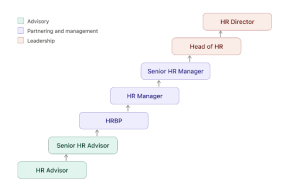
Advancing from an HR Manager career path into executive leadership requires taking on greater strategic ownership at every step. Recognising what changes at each stage helps professionals prepare for their next career move.
HRBP → HR Manager
The shift: Moving from advising the business to owning a broader HR function.
As an HRBP, you act as a strategic workforce partner for key business units. As an HR Manager, you become accountable for HR performance and guide leaders in restructuring their teams.
HR Manager → Head of HR
The shift: Moving from managing HR activity to leading the organisation’s people strategy.
A Head of HR leads the entire HR function for mid-sized companies, shaping high-level strategy rather than just executing it.
Head of HR → HR Director/CPO
The shift: Moving toward leading a people strategy that shapes the enterprise.
C-suite executives shape enterprise strategy, executive leadership, board influence, transformation, and commercial outcomes.
What Factors Influence HR Salaries in 2027?
HR salary guides are useful benchmarks, but they should not be absolute rules that dictate pay. Specialised skills, overall impact, location, and industry play a crucial role in determining fair pay.
Location
Pay for similar HR roles can vary across Australian cities, shaped by the concentration of head offices, the mix of industries and local competition for talent. Here is the list of Australian cities, ranked from highest to lowest average HR salary:
- Sydney: Often supports higher salary levels and strong competition for senior talent.
- Melbourne: Strong performance across professional services, healthcare, education, and manufacturing.
- Brisbane: Pay can be competitive depending on the sector.
- Perth: Competitive demand for senior HR and industrial relations talent, particularly across operations and projects.
- Canberra: Pay structures are generally fixed in structured salary bands, as the private-sector market is relatively small.
- Adelaide: Salaries tend to be lower, though specialist roles in areas such as defence and healthcare can be competitive.
Industry
Salary expectations may differ across these industries:
- Technology
- Financial services
- Healthcare
- Construction
- Mining/resources
- Professional services
- Manufacturing
Organisation Size
An HR Manager in a 150-person organisation can have a completely different remit from one responsible for thousands of employees.
Scope
The scope of the role often drives more pay. Key questions to consider include:
- Number of direct reports
- Number of employees supported
- Geographic scope
- Executive exposure
- Strategic responsibility
Location, industry, organisation size and scope all shift what a role is worth. Use the HR salary guides as a reference point alongside a clear understanding of what the role actually involves.
How Businesses Should Benchmark HR Salaries
Getting HR pay right matters for hiring, retention and fairness. For HR Directors, CEOs and business leaders, these five steps provide a practical process.
Step 1: Benchmark the actual role
Don’t rely solely on the job title. Start by defining what the person will actually do and find comparable roles in the market. If the title and the actual job scope don’t match, the benchmark will be misleading.
Step 2: Assess responsibilities
Look at the factors that most influence what it is worth:
- Workforce size
- Team size
- Complexity
- Reporting structure
- Strategic responsibilities
Step 3: Review market data
Compare against relevant salary benchmarks. Use sources that reflect the right location, industry and organisation size. High-demand capabilities, such as industrial relations or workforce analytics, can attract a premium above the typical range.
Step 4: Consider internal equity
Ensure the proposed salary makes sense relative to existing employees. Compare the offer with peers and the people the role will lead.
Step 5: Consider the complete package
Salary isn’t everything. Candidates consider the full compensation package, not just base salary, when deciding whether to accept an offer. Include:
- Base salary
- Superannuation
- Bonus
- Flexible work
- Benefits
- Professional development
- Career progression
What is the average HR salary in Australia in 2027?
The average HR salary in Australia in 2027 ranges from $60,000 to $140,000+ per year, depending on experience level, specific role, and location.
What does an HR Manager earn in Australia?
An HR Manager in Australia can earn about $140,000 to $200,000 per year, depending on their specialised skills, location and industry.
What is the typical HR career path?
A typical HR career typically begins with running processes, then moves to advising on people issues, and finally to shaping how the organisation manages its workforce. At each stage, the work becomes less operational and more strategic.
What is the HR career ladder?
An HR career ladder starts at the entry level (HR Assistant, HR Administrator), moves to the advisory level (HR Advisor, Senior Advisor), then to the partnering and management level (HRBP, HR Manager, Senior HR Manager), and ends in leadership roles (Head of HR, HR Director).
How do you become an HR Manager?
As an HR Manager, you own the HR function, lead teams, and drive people strategy and organisational priorities.
How can I progress my HR career?
Specialised HR capabilities such as Strategic Workforce Planning, Commercial Acumen, and data and analytics can help you progress in your HR career.
What HR skills attract the highest salaries?
AI literacy, strategic decision-making, workforce analytics, and organisational design are among the skills that can attract the highest HR salaries in Australia.
Will AI change HR jobs?
AI has replaced HR tasks while redefining the capabilities organisations value and reward. It is changing what employers value, which will likely reshape where the premium sits.
Which HR roles will be in demand in 2027?
The HR roles most likely to be in demand in 2027 will focus on bridging data, technology, and compliance, including the emerging HR profile: the AI-enabled HR leader.
The Future of HR Careers and Salaries
The future of HR careers and salaries suggests that impact drives income. Job titles and tenure still matter, but your responsibilities, the complexity of the problems you solve, and your direct impact on company success matter just as much.
For HR professionals, your earning potential increasingly depends on the scale of your impact, not just years of experience. For employers, understanding the market is essential to attracting and retaining high-performing HR professionals.
As AI reshapes how HR teams operate, professionals who combine people expertise with strategic, commercial, data, and technology capabilities may be best positioned to command a premium in the market.
Looking to hire HR talent in 2027? Civitas Talent connects organisations with exceptional HR professionals, from HR Advisors and HR Business Partners through to senior HR executives.
Talk to Civitas Talent about our HR Recruitment Services.
Related Post

Government hiring carries a compliance burden most private-sector RPO models are not built for. What a pu...

Seasonal peaks break standard recruitment models. How retail RPO handles volume hiring across a national ...

Manufacturers, dealers and parts networks hire on three different clocks. How automotive RPO covers all t...
Intelligence for high-performing people & safety teams.
We love hearing from you and we’ll get back to you as soon as possible.
Stay ahead of the curve with the latest HR and HSE insights, delivered straight to your inbox.